How to Choose, Integrate, and Calibrate an IR Lens for FLIR Boson and Boson+ Thermal Camera Modules
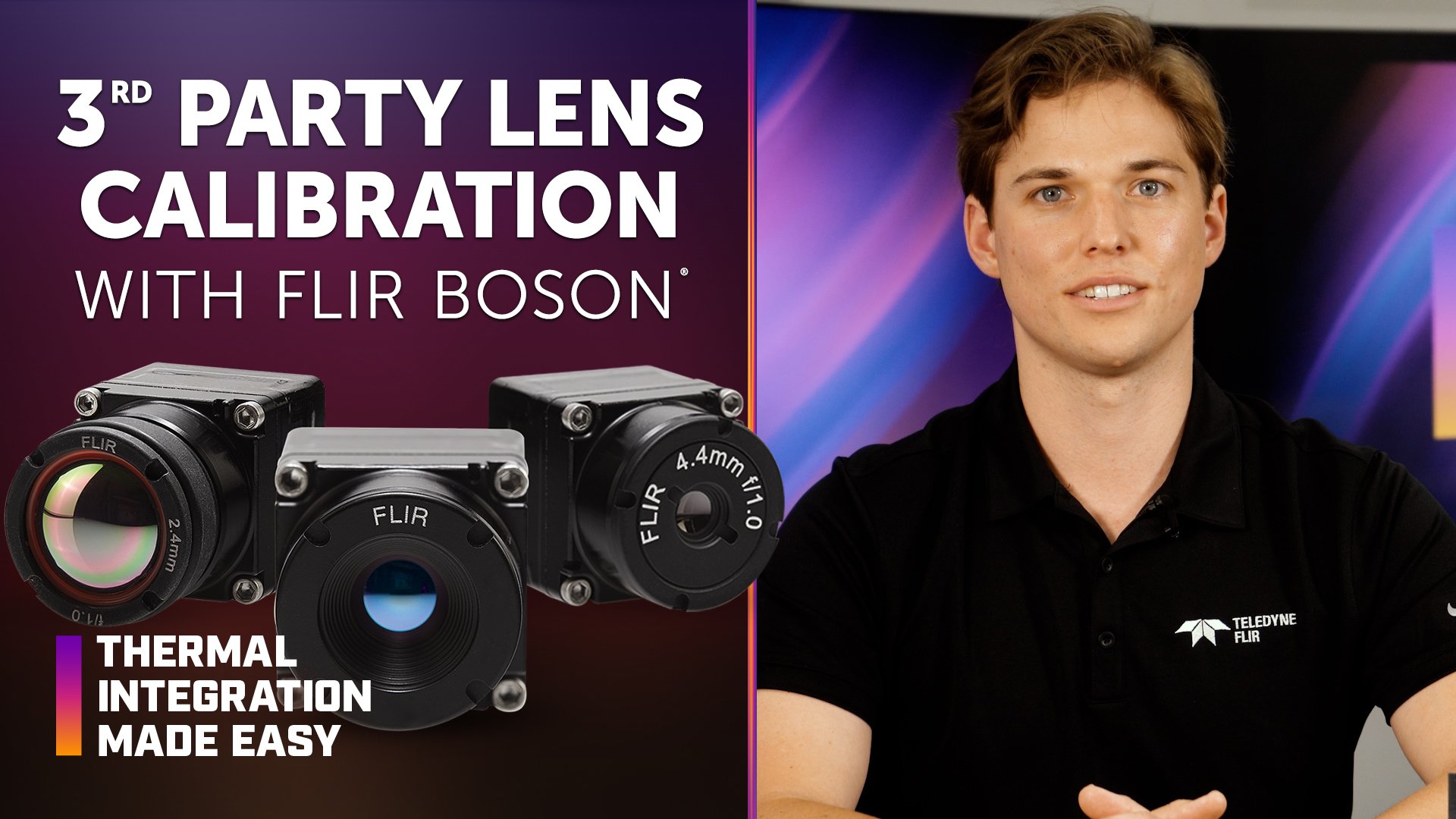
Selecting and calibrating the right infrared (IR) lens is an important part of integrating FLIR Boson® and Boson+ thermal camera modules. Lens focal length, optical performance, mechanical design, environmental requirements, and calibration can all affect the performance and image quality of the final thermal imaging system.
In this episode of Thermal Integration Made Easy, OEM engineers and developers learn how to select a lens based on target size, distance, and required pixels on target, as well as the additional requirements associated with integrating a third-party lens. The video covers lens-holder design, optical and mechanical considerations, lens gain calibration, flat-field correction (FFC), blackbody requirements, focus testing, and modulation transfer function (MTF).
Key Takeaways
How is the right lens focal length selected for FLIR Boson and Boson+?
Three important factors are the distance to the object, the object's width or height, and the desired number of pixels across the smaller target dimension. The FLIR Lens Selector Tool can help developers evaluate these factors and select an appropriate focal length.
How many pixels are needed for detection, recognition, and identification?
The video uses a minimum of two pixels across the target for detection, four for recognition, and eight for identification. The required performance should be considered along with target size and distance when selecting a lens.
What should be considered when integrating a third-party lens with Boson?
The video identifies eight considerations: focus retention, sealing, mechanical mounting, insulation, calibration, cleanliness, environmental durability, and optical quality and performance.
Why is lens F-number important?
A lower F-number allows more infrared energy to reach the detector. The video identifies an F/1.0 optic as ideal and notes that an F/1.1 optic loses approximately 20% compared with an F/1.0 optic.
What optical characteristics should be evaluated when selecting an IR lens?
Relative illumination, modulation transfer function (MTF), and transmission are important characteristics. Lens performance should be tested and understood before the optical design is finalized.
What mechanical and environmental factors should be considered?
The lens should be thermally conductive to the lens holder and camera-core interface, and focus testing should be incorporated after installation. Outdoor applications also require a solar-blocking filter, according to the video.
Does a new lens need to be calibrated for FLIR Boson?
Yes. The video states that lens calibration is required for all lenses installed on Boson. Calibration improves image uniformity by correcting for factors including relative illumination and out-of-field irradiance.
When should image quality be evaluated?
Image quality should be evaluated after lens calibration is complete. Assessing image quality before calibration may not accurately represent the performance of the final camera and lens assembly.
What is required for Boson lens gain calibration?
Lens gain calibration requires two blackbodies, including one that can be heated. The video specifies a cold ambient surface and a hot 40°C surface, with the calibration captures performed in quick succession.
Why should the blackbody be moved instead of the camera during calibration?
The video recommends moving the blackbody rather than the camera core so the camera remains in a consistent position while the calibration data is collected.
What calibration is required after lens gain calibration?
Supplemental flat-field correction calibration should be performed after lens gain calibration using an ambient blackbody.
What is MTF and why is it important for lens focusing?
MTF measures the optical sharpness of an optical assembly. MTF testing can be used after lens installation to evaluate focus and optical performance.
Where are FLIR Boson lenses typically focused?
Teledyne FLIR focuses Boson lenses at infinity. Some applications may benefit from focusing at the hyperfocal distance, depending on the required near-focus distance and depth of field.
Can a standard Boson lens holder support continual focus adjustment?
The video states that Teledyne FLIR lens holders are not intended for continual readjustment. Applications requiring frequent or long-term focus adjustment may require a redesigned lens holder.
How to Integrate and Calibrate a Third-Party Lens for FLIR Boson and Boson+
Determine the required focal length.
Target distance, target dimensions, and required pixels on target should be established before selecting the lens. The FLIR Lens Selector Tool can help evaluate available options.
Evaluate optical performance.
F-number, relative illumination, MTF, transmission, and overall optical performance should be assessed before finalizing the lens design.
Design and qualify the lens holder.
A third-party lens requires a compatible lens holder that accounts for focus retention, sealing, mechanical mounting, insulation, cleanliness, and environmental durability.
Account for the operating environment.
Thermal conductivity between the lens, lens holder, and camera-core interface should be considered. Outdoor applications should incorporate the solar-blocking filter described in the video.
Perform lens gain calibration.
A cold ambient blackbody and a hot 40°C blackbody are used to collect the required calibration data in quick succession, ideally by moving the blackbody rather than the camera.
Perform supplemental FFC calibration.
After lens gain calibration, supplemental flat-field correction should be calibrated using an ambient blackbody.
Focus the installed lens.
Focus testing should be completed after installation. MTF measurement can help evaluate the sharpness of the camera and lens assembly.
Evaluate final image quality.
Image uniformity, sharpness, and overall performance should be evaluated after calibration and focusing are complete.
Products & Technology Featured
FLIR Boson and Boson+ Thermal Camera Cores
FLIR Boson and Boson+ are compact, uncooled longwave infrared (LWIR) thermal camera cores designed for OEM integration across applications including autonomy, security, industrial inspection, and other embedded thermal imaging systems.
The Boson Lens Selector Tool helps developers evaluate lens focal length based on target distance, target dimensions, and the desired number of pixels on target.
Boson Camera Adjustments Application Note
Looking for additional technical resources or support? Visit our Support Center for documentation, software downloads, and troubleshooting guidance.
Related Documents
- Boson+ Datasheet
- Boson+ CZ Datasheet
- Boson Datasheet
- Boson Engineering Datasheet
- Boson Family Brochure
- 5 Factors Influencing Radiometric Temperature Measurements
Application Notes & Tools
- Boson Camera Adjustments Application Note
- Boson FFC/NUC Control Application Note
- Boson Development Board Application Note
- Boson Lens Selector Tool
Boson GUI Download