How FLIR Prism AI Adds AI-Powered Perception and Decision Support to Thermal Imaging
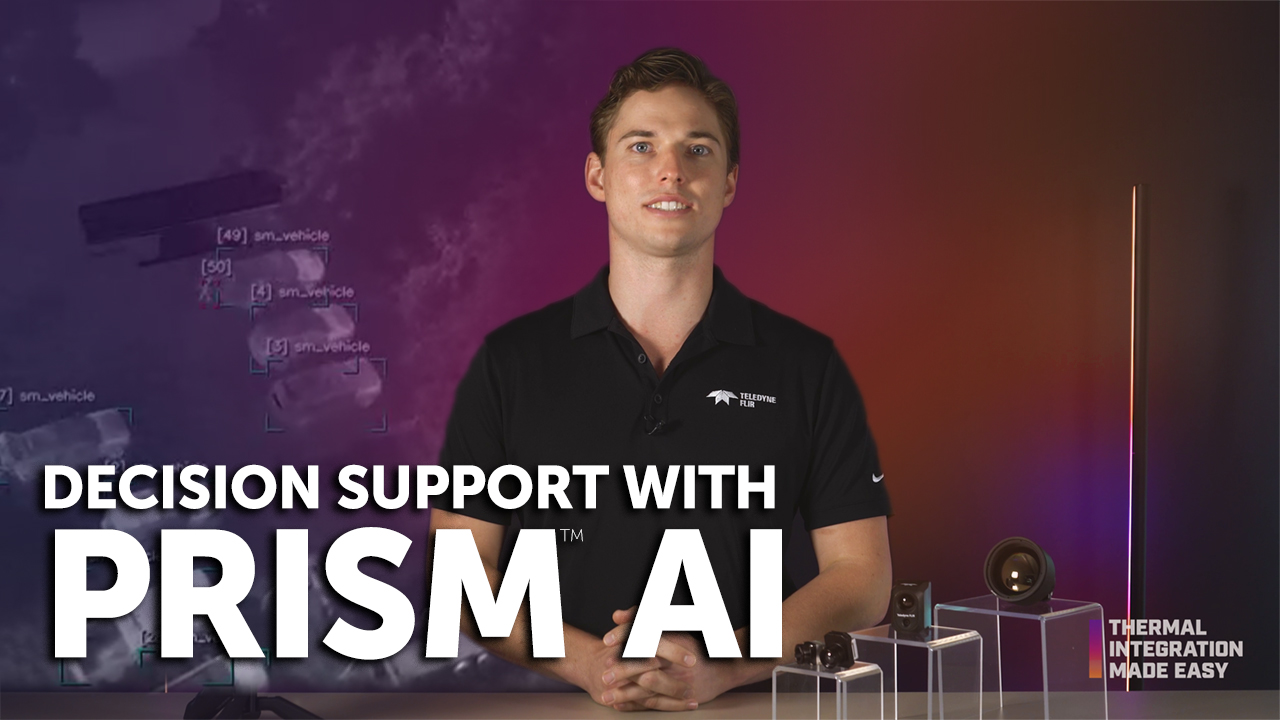
AI Decision Support with Prism AI
FLIR Prism™ AI combines thermal imaging with artificial intelligence (AI) to enable automated object detection, classification, tracking, and real-time decision support at the edge. Application-specific perception models help reduce reliance on traditional computer vision techniques and manual processes while enabling embedded imaging systems to interpret scene content and identify targets of interest.
In this episode of Thermal Integration Made Easy, engineers and developers learn how Prism AI works with Teledyne FLIR thermal camera cores and embedded processors to support autonomous transportation, air-to-ground observation, ground intelligence, surveillance and reconnaissance (ISR), counter-uncrewed aircraft system (C-UAS) missions, and commercial security applications. The video also explores Prism AI Auto, motion target indication (MTI), neural network-based object detection, and application-specific thermal and electro-optical (EO) datasets.
Key Takeaways
What is FLIR Prism AI?
Prism AI is perception software that uses application-specific models to provide capabilities including object detection, classification, and tracking. It is designed to add AI-enabled perception and decision support to systems using Teledyne FLIR thermal camera cores.
What is computational imaging?
Computational imaging combines the parallel design of image-processing hardware and computer algorithms to create imaging systems with capabilities beyond conventional imaging alone.
How does Prism AI support edge AI applications?
Prism AI is designed for low-power embedded processors, including platforms from Qualcomm and NVIDIA. Running perception capabilities at the edge allows imaging systems to detect, classify, and track objects without relying solely on manual analysis or traditional rule-based computer vision techniques.
What data is used to train Prism AI models?
According to the video, Prism AI application-specific models are trained using a large thermal and electro-optical dataset containing more than 40 target classes. Individual Prism AI applications use datasets developed for their specific operating environments and targets.
What is Prism AI Auto?
Prism AI Auto is a perception software stack for automotive applications trained on more than 4 million annotation assets. The video states that it can detect up to 15 object classes, including vehicles, pedestrians, cyclists, traffic signs, and large animals.
How can thermal imaging and Prism AI support automotive safety?
Thermal imaging can provide perception in darkness and challenging conditions, including sun and headlight glare and atmospheric conditions. When paired with Prism AI, thermal camera cores can help identify road users and other objects to support pedestrian safety and autonomous transportation systems.
How does Prism AI support air-to-ground applications?
Air-to-ground detection requires models designed for the different perspective and viewing angle associated with airborne imaging. Teledyne FLIR developed a dedicated air-to-ground dataset that allows Prism AI to detect and track people, vehicles, and marine vessels for applications including search and rescue and law enforcement.
How can Prism AI be used with uncrewed aircraft systems?
Prism AI provides air-to-ground object detection and tracking designed for embedded processors used in uncrewed aircraft system (UAS) applications. The video identifies Qualcomm RB5-series and NVIDIA Xavier and Orin platforms as examples.
What is ground ISR in Prism AI?
Ground ISR capabilities are designed to improve situational awareness from a ground-based perspective. Detection, identification, and tracking of long-range targets can reduce operator workload and support applications such as perimeter security, border security, and infrastructure protection.
What is the Prism MTI?
The Prism MTI can detect and track moving targets before enough pixels are available for an AI-based image classifier to make a high-confidence object detection. This can extend target awareness beyond the range at which classification becomes possible.
How does Prism AI support counter-UAS applications?
Counter-uncrewed aircraft system (C-UAS) applications require distinguishing small drones from objects that can create false alarms, such as birds. According to the video, the Teledyne FLIR drone detection model was trained using more than 1 million UAS annotation assets and more than 1,000 bird object annotations.
How can Prism AI support security and perimeter monitoring?
Prism AI combines motion detection, object tracking, and trained neural networks to detect and classify people and vehicles. These capabilities can add automated intelligence to thermal security cameras used for airports, transportation hubs, government facilities, critical infrastructure, and other monitored environments.
What is the advantage of pairing Prism AI with Teledyne FLIR thermal camera cores?
Combining application-specific perception software with thermal imaging and compatible embedded processors can simplify development, reduce integration costs, and accelerate time to market for AI-enabled imaging systems.
Products & Technology Featured
Prism AI is perception software designed to add object detection, classification, tracking, and decision-support capabilities to thermal and electro-optical imaging systems. Application-specific models support embedded AI applications across transportation, security, airborne imaging, and other perception systems.
Prism AI Auto is a perception software stack developed for automotive and autonomous transportation applications. Its trained models detect multiple classes of road users and objects while leveraging thermal imaging to provide perception in darkness and challenging environmental conditions.
Teledyne FLIR Thermal Camera Cores
Teledyne FLIR thermal camera cores can be paired with Prism AI and compatible embedded processors to provide the thermal imagery used by AI-enabled perception systems.
Looking for additional technical resources or support?
Visit our Support Center for documentation, software downloads, and troubleshooting guidance.